
1971-D Quarter vs 1971-P: Is There a Real Market Difference?
Many collectors checking the 1971 D quarter value assume the Denver and Philadelphia coins behave the same. Same year. Same design. Same metal. At the first glance, they look absolutely identical.
Yet auction records sometimes show different outcomes. Thus, here appears the question: does one mint truly hold an advantage, or is the gap mostly perception?
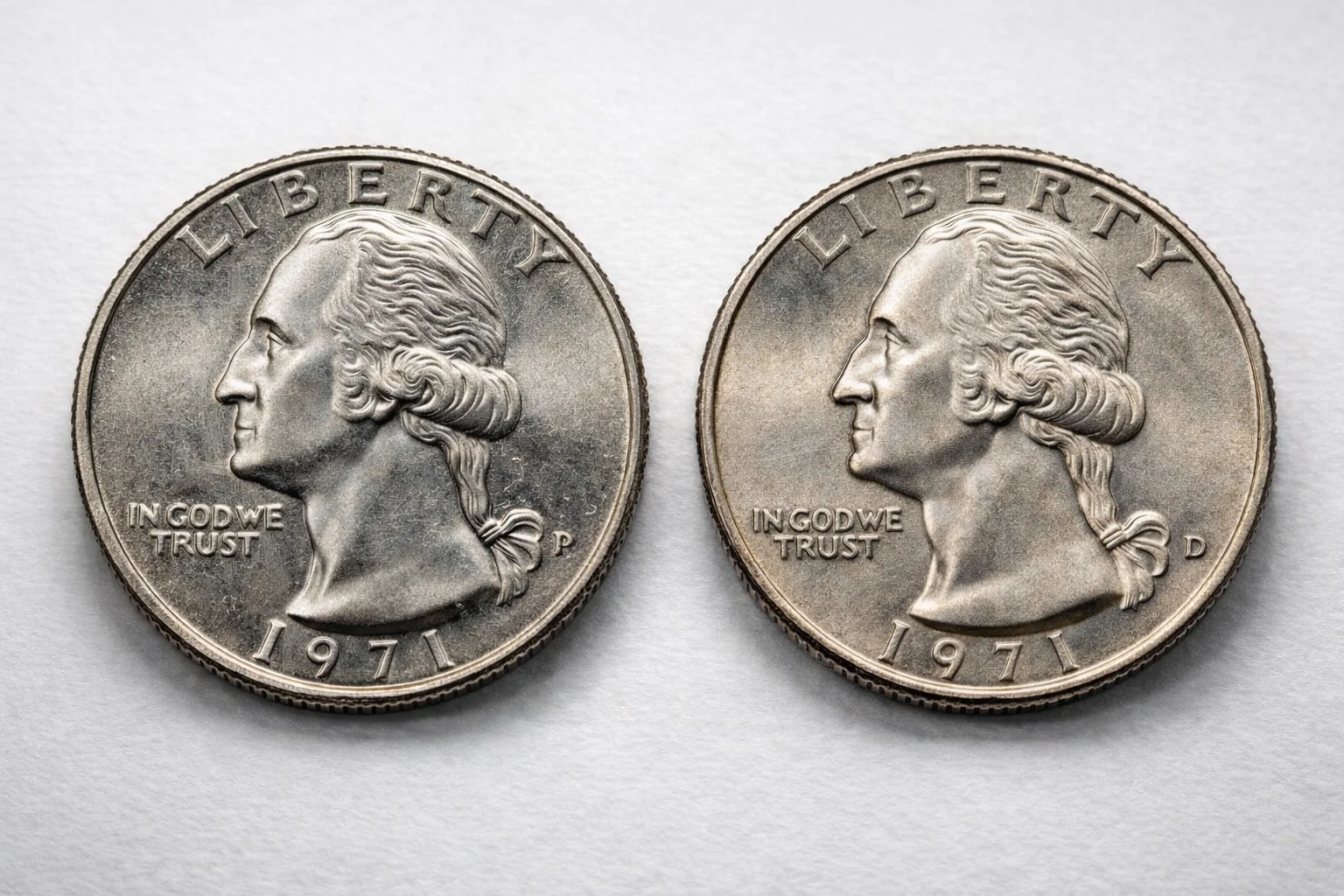
Shared Specifications: Same Coin, Different Mint
Both versions are standard Washington quarters of the clad era. Please refer to the table to check the main characteristics of both quarters:
Parameter | Specification |
Year | 1971 |
Series | Washington Quarter |
Composition | Copper core with nickel-clad outer layers |
Weight | 5.67 grams |
Diameter | 24.3 mm |
Edge | Reeded |
Designer | John Flanagan |
The metal is identical. The design is identical. The difference is only the mint mark: “P” for Philadelphia and “D” for Denver. However, the metal composition and design of the quarter is the same, any price difference must come from production quality, survival rate, or market demand.
Production Totals: Does Mintage Matter?
Here are the official mintages:
Mint | Mintage |
1971-P | ~109,284,000 |
1971-D | ~258,634,000 |
Denver struck more than twice as many coins as Philadelphia.
At first glance, this suggests the Philadelphia issue should be more desirable. Lower production often creates stronger demand. But that logic works only when survival rates differ meaningfully.
Both figures are high. Neither coin qualifies as a low-mintage issue. Tens of millions were released into circulation. From a pure output standpoint, both are common.
Mintage measures how many were made. It does not measure how many survived in high grade.
Strike Characteristics: Subtle but Noticeable
Early 1970s clad quarters share certain traits. They were struck in large volumes. Bags were heavy. Coins contacted each other frequently.
1971-D Strike Profile
Denver output was high. Many examples show moderate contact on Washington’s cheek. The eagle’s breast can appear slightly flat on some pieces. Luster is often strong but interrupted by small marks.
This does not mean weak strike is universal. Strong examples exist. But consistency is not perfect.
1971-P Strike Profile
Philadelphia produced fewer coins. Some collectors note slightly sharper eagle detail on average. Surface quality varies widely. Some coins show a better balance between fields and devices.
The difference is not dramatic. It is visible only under careful inspection. In circulated grades, these differences disappear. In Mint State, they begin to matter.
Circulated Market: No Real Separation
In worn condition, both mints trade at face value.
A circulated 1971-P and a circulated 1971-D show no structural difference. Condition, not mint mark, controls price.
Current Market Levels (Circulated to MS63)
Grade | 1971-P | 1971-D |
G–VF | $0.25 | $0.25 |
XF | $0.25 – $0.35 | $0.25 – $0.35 |
AU50–AU58 | $0.35 – $0.75 | $0.35 – $0.75 |
MS60–MS62 | $1 – $3 | $1 – $3 |
MS63 | $3 – $8 | $3 – $8 |
Prices reflect typical U.S. market activity for problem-free coins. Costs can change with time and other factors.
At this level, the market treats them equally. Minor variations reflect eye appeal, not mint origin.
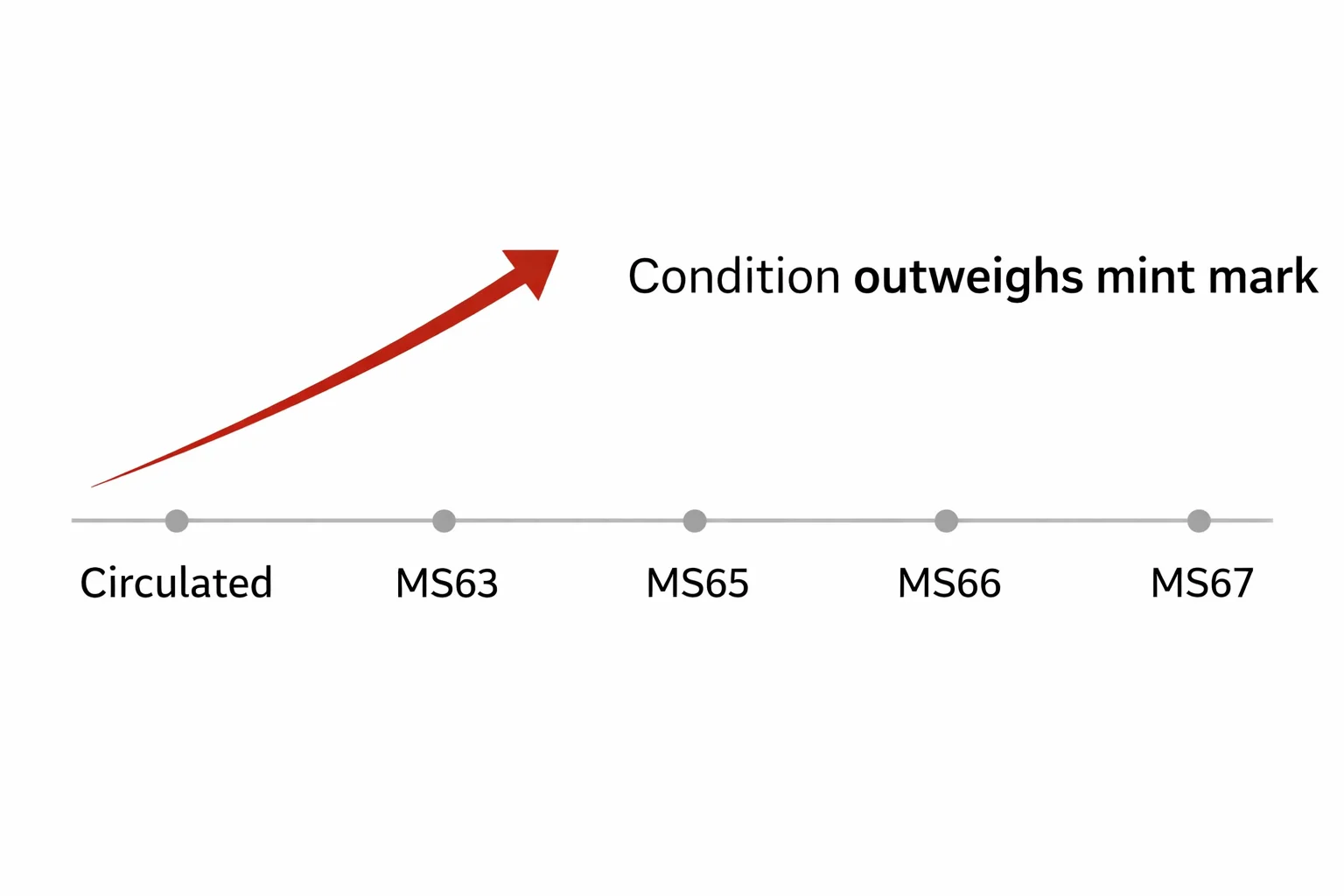
Mint State Grades: Where Things Change
Once coins enter Mint State territory, separation becomes possible.
MS63 to MS65
Both mints are widely available. Prices remain modest. Surface marks are common. Eye appeal varies. No consistent premium favors one mint over the other.
At this stage, condition dominates. Mint mark rarely influences the result.
MS66
Clean surfaces become harder to find. Clad coins from this era mark easily. Coins stored in mint bags often developed small abrasions.
At MS66, population numbers begin to thin. Still, neither mint holds a decisive advantage.
MS67
Here, the structure shifts.
MS67 examples are scarce. Surfaces must be nearly flawless. Luster must be strong and undisturbed. Contact marks must be minimal.
At this level, small differences in certified populations can influence price. A slight numerical edge for one mint can change bidding behavior.
This is where auction headlines appear.
Current Market Levels (MS63 and Above)
Grade | 1971-P | 1971-D |
MS63 | $3 – $8 | $3 – $8 |
MS64 | $8 – $18 | $8 – $18 |
MS65 | $18 – $45 | $20 – $50 |
MS66 | $70 – $140 | $80 – $160 |
MS67 | $800 – $1,600 | $900 – $1,950+ |
Values represent current market ranges and exclude exceptional auction spikes. Final prices depend on grading service, population shifts, registry demand, and visual quality. Clad coin markets are especially sensitive to surface preservation.
MS67 prices reflect certified examples and can vary significantly depending on eye appeal and auction competition.
Auction Behavior: What the Market Shows
Mid-grade coins trade steadily. MS63 through MS65 examples show similar results between mints.
At MS67, variation appears. One coin may sell significantly higher than another of the same grade from the opposite mint.
Why?
Three reasons:
Eye appeal differences.
Registry competition.
Population perception.
Two coins graded MS67 are not identical. One may have cleaner fields or stronger cartwheel luster. Buyers respond to visual quality, not just the label.
Auction premiums often reflect competition intensity. A single strong bidder can move the result far beyond guide levels.
The mint mark alone does not explain the full picture.
Why Population Reports Do Not Tell the Full Story
Population reports list how many coins have been certified at each grade. They are useful. They are not complete.
First, they show only submitted coins. Many high-grade pieces remain raw. Some may be upgrade candidates.
Second, they do not show how often coins trade. A coin locked in a long-term collection reduces available supply.
Third, they do not measure demand. A small difference in population may look significant. If demand is weak, price impact remains limited. If registry competition is strong, even a small difference can create pressure.
For example, if one mint shows slightly fewer MS67 coins certified, buyers may assume greater rarity. That perception can shift prices upward, even if the difference is narrow.
Population numbers describe certification totals. They do not describe real-time market dynamics.
Clad Coin Survival: A Material Limitation
Early clad coinage has its own challenges.
The copper core is bonded to nickel layers. Contact marks show easily. The high points of Washington’s portrait flatten quickly. The fields lose brilliance from bag friction.
Silver coins from earlier decades often develop softer toning and mask minor marks. Clad coins do not. They reveal surface damage clearly.
This material behavior limits the number of truly clean survivors from both mints.
In many cases, the survival rate influences value more than original mintage.
Eye Appeal vs Mint Mark
Collectors sometimes focus too much on the letter beneath Washington’s neck.
In reality, surface quality dominates.
A sharply struck 1971-D with bright luster and clean cheeks will outperform a dull 1971-P with scattered marks.
Buyers examine:
Washington’s cheek for abrasions.
The eagle’s breast for flatness.
Field reflectivity.
Luster continuity.
Mint mark becomes secondary at equal grade.
When comparing similar coins across mints, some collectors use reference tools such as Coin ID Scanner to confirm estimated price and specifications quickly before deeper grade analysis. Clear identification avoids confusion when studying closely related issues.
Still, identification alone does not determine the premium. Surface preservation does.
Practical Market Interpretation
For most collectors, the difference between 1971-P and 1971-D is minimal.
In circulated condition, they are equal.
In mid-Mint State, they are comparable.
Only at MS67 and above does separation begin. Even then, results depend on eye appeal and buyer intensity.
Lower mintage does not automatically create stronger long-term performance. High-grade preservation controls value more than production totals.
Conclusion
The market difference between 1971-P and 1971-D is conditional, not structural.
Both coins are common by mintage. Both suffer from early clad surface sensitivity. Both become scarce in near-perfect condition.
Auction results may suggest temporary gaps. Population data may hint at differences. Yet the underlying reality remains simple.
Condition outweighs the mint mark.
When evaluating a 1971 quarter, focus first on surface quality. Then consider grade level. Only at the top tier does mint origin begin to influence pricing.
For most collectors, the two mints are equal. The premium depends on preservation, not production.
Popular

Understanding the Impact of Regulatory Changes on Cryptocurrency Markets
Cryptocurrency markets have experienced significant growth and volatility in recent years, attracting both seasoned investors and newcomers looking to capitalize on the potential gains in this emergin...

How to Use Leverage Safely in Crypto Margin Trading
Cryptocurrency trading can be a lucrative venture, but it also comes with its fair share of risks. One way for traders to potentially amplify their gains (or losses) is through the use of leverage in ...

1971-D Quarter vs 1971-P: Is There a Real Market Difference?
Clear comparison of 1971-D and 1971-P quarter value, mintage, strike quality, high-grade premiums, and real market behavior from MS63 to MS67....